- The BBC has a website with links to the many resources for people wanting to learn Welsh.
- From 'The Economist' print edition 11/08/2005 page 27 (Register with Economist.com)
Welsh
From mother tongue to meal ticketCardiff and Faenol
Why the Welsh language is making a comebackSCARCELY a word of English was uttered last week in Faenol, a grand estate that hosted the Eisteddfod, a sort of nationalistic arts festival for Wales. Nor is English the local language of choice. In this region, Welsh takes precedence on road signs—and the English words are often illegible, thanks to the patriotic application of spray paint. In the county of Gwynedd as a whole, 70% of people can speak Welsh. Walk into a shop here, and the conversation is likely to begin: “Ga i helpu?”
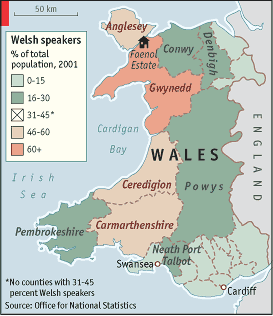
Given the nearness of England, an infamous linguistic coloniser, the mere survival of such an ancient language is remarkable. Odder still, Welsh is holding steady. Between 1991 and 2001, the share of the population who claimed to be able to speak the language actually went up from 19% to 21%—the first increase in over a century. And the proportion of Welsh-speakers is likely to increase further, since teenagers are much more likely to be able to speak the language than their parents.
That ought to be a source of pride in a country where identity is closely tied to the ancestral tongue. While Scottish nationalists demand political independence, the Welsh just want everyone to speak the lingo. Since 1993, public agencies have been obliged to provide a bilingual service, even in areas where few people understand Welsh. Court cases can be heard entirely in the language, if the plaintiff or the defendant chooses. Midwives even encourage new parents to speak the tongue to their babies.
The Welsh Language Service, which was previously called the Welsh Language Board, promotes the use of Welsh. The Welsh Language Act gives Welsh legal status. The 2001 census showed the proportion of people using Welsh by community. The Welsh Language Society is a pressure group.
Yet Welsh-language campaigners are in a dismal mood. Aran Jones of Cymuned (Community) believes the language is in a much worse state than national statistics suggest. In the hilly north and west of Wales, where the native language is strongest, the Welsh-speaking population is being diluted by migration (which Mr Jones calls “colonisation”) from England. Children may be familiar with Welsh, but only in the sense that English schoolchildren are familiar with French—as an academic discipline, not as a natural tongue.
Welsh is, indeed, slowly dying in the heartlands. Between 1991 and 2001, Welsh speakers declined in number in the five mostly rural counties where they had been most common. As a rule of thumb, say linguists, a minority language will die out if it is spoken by fewer than 70% of the population. Ominously, the number of wards where that density was achieved fell from 87 to 58 during the 1990s.
Nationalists are divided over what to do. The extreme 1960s and 1970s response, which consisted of blowing up pipelines and burning holiday cottages owned by Anglophones, is out of style. The Welsh Language Society, a pressure group that has seen many of its demands incorporated into law, wants restrictions on house-building in Welsh-speaking areas and a language act that would require businesses to deal with customers in their preferred language. One of its members went on hunger strike during the Eisteddfod, just to show it was serious. Cymuned believes still more drastic measures are needed. It wants independence for the Welsh-speaking heartlands.
The battle for the heartlands is bound to end in defeat. But Welsh is growing in places where it was virtually unknown a few decades ago. In Cardiff, where the signs are bilingual (but, significantly, English takes precedence over Welsh), the proportion of people who can speak the language has increased from 5.8% to 10.9% in the past two decades. More than a tenth of the population of Wales lives in the city. Welsh is also growing rapidly in the former industrial and coalmining area of south Wales known as the Valleys.
That may partly be because these are the ugliest bits of Wales, so English settlers tend to steer clear of them. But the main reason is probably the growth of Welsh schooling since the 1960s. There are now 448 primary schools and 54 secondary schools that teach mostly or entirely in Welsh, many of them in the south-east. They tend to be good schools, so many middle-class parents who do not speak Welsh patronise them.
As a result, says Colin Williams, a Cardiff University linguist, the schoolroom is replacing the home as the main pillar of the language. And pupils pick up more than Welsh. Because the demanding parents who send their children to Welsh-language schools tend to have demanding children, the schools are nurturing a new generation of articulate nationalists.
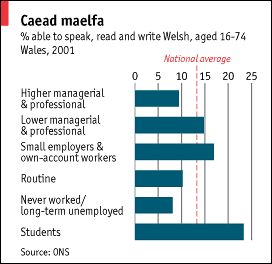
Another reason for the growth of Welsh has to do with the job market. Many of the best paid, most stable and most interesting jobs in Wales demand knowledge of the language—or are thought to demand it, which is just as important. Thanks to the language laws, the country's swollen public sector is hungry for bilinguals; so are the burgeoning government-supported Welsh media. According to the 2001 census, 20% of people employed by culture, media or sporting outfits could speak, read and write Welsh, compared with just over 13% of all people aged 16-74. That, in turn, encourages politicians and other public figures to learn the language. Lisa Francis, a Conservative member of the Welsh Assembly, says she has given more interviews in Welsh than in her native tongue. All but two of her ten colleagues speak Welsh or are learning it.
Welsh-speakers tend to be middle managers or small-business owners (see chart). They are less likely to be found in the highest ranks of business and the professions, but they are also much less likely to be unemployed than monoglot English speakers. High demand means that they earn more, too. A recent study by Andrew Henley of Swansea University found that, after controlling for residence and education, Welsh speakers earned 6-8% more than the competition. Another study, for the Welsh Assembly, estimated the earnings premium at more than 10%.
There is a message here for other linguistic nationalists, from the Québécois to the Basques. Forget bombings and hunger strikes: to ensure the survival of a language, create a closed shop.
Source: Welsh Language Board.
- Until the mid-1800s, over 80% of people in Wales could speak Welsh
- Factors causing its decline included the Industrial Revolution, with the fall continuing in the 20th Century.
- The 1991 census found 508,000 Welsh speakers in Wales (18.7%)
- But the 2001 census showed the number increased by 2.1% to 582,000 speakers, (20.8% of the population in Wales)
- The 2001 census also showed 457,946 (16.3%) can read, write and speak Welsh
- In 2001 797,717 (28.4%) people had at least one skill in Welsh, either understanding, speaking, reading or writing

In April 2012, the 'Welsh Language Board' was replaced by the 'Welsh Language Commissioner', appointed by the Welsh government. There is a list of standardized Welsh Place-names.
Updated 20/02/2022